

Who we are
CheckUP works with partner organisations and health providers to create healthier communities and reduce health inequities through a range of initiatives.
View allWhat we do
CheckUP works with partner organisations and health providers to create healthier communities and reduce health inequities through a range of initiatives.
View allPartner with us
There are so many ways you can support the work of CheckUP and our vision of better health for the people and communities that need it most.
View allThis month, Gateway to Industry Schools Program – Health (GISP), in collaboration with Mandy Elliott from the Department of Education, hosted two Industry Tours for students in Mackay and Townsville.
Mackay Industry Tour
On 5 March, GISP hosted an Industry Tour for 30 students, including 20 students from Proserpine State High School and 10 students from Collinsville State High School. Students began their journey to Mackay early, departing at 5:00am to participate in the day’s activities.
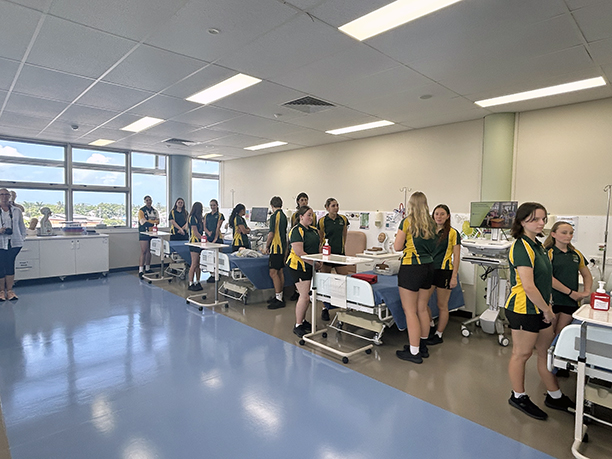
The tour commenced at Mackay Base Hospital, where students were welcomed by Kristy Fuller and her team of educators. The team delivered an informative presentation outlining the wide range of careers available within the health sector. A highlight of the session was hearing from Dr Bill, who shared his unique career journey, explaining how he initially began studying to become a veterinarian before transitioning into medicine.
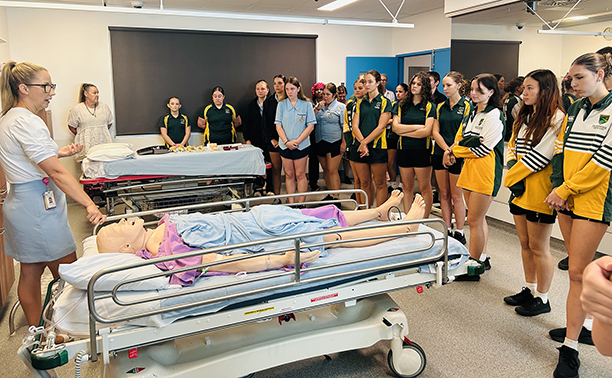
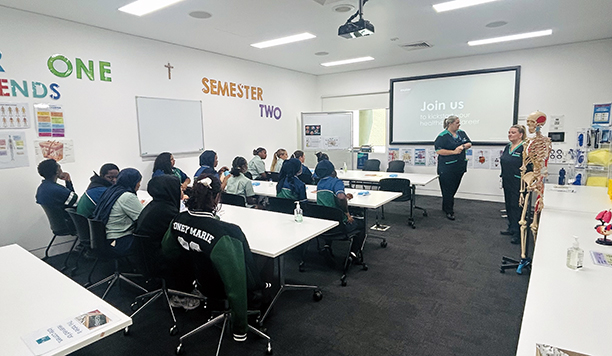
Following the hospital visit, students travelled to Central Queensland University where Lily from the enrolments team presented information about the SUN Program. This program provides students in Years 10, 11 and 12 with the opportunity to study university-level units while still at school. Upon successful completion, students may be eligible for direct entry into a related university course and receive credit towards their degree. The program also offers an alternative pathway to university that is not solely reliant on an ATAR score. From there the students were able to participate in hands on activities with the Nurse Educators and learn about first aide. 30 amazing students who were so well behaved and polite it was an honour to host this event for them.
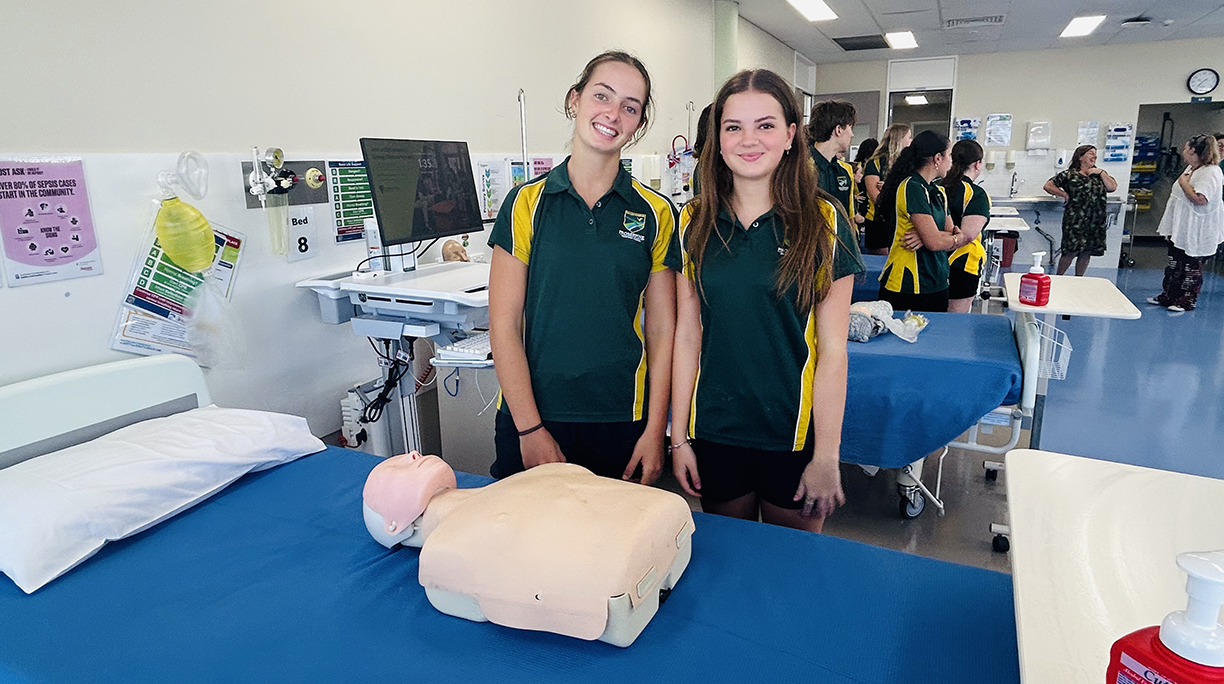
The images above show hands-on hospital tours which give students a glimpse into the many pathways available in the medical field.
Townsville Industry Bus Tour
On 6 March, 20 students from Townsville State High School participated in an industry bus tour, visiting TAFE Queensland, Mater Hospital and the Royal Flying Doctor Service (Queensland Section). The day provided students with the opportunity to explore a range of careers and pathways into the health sector.
At TAFE Queensland, students learned about healthcare courses available for 2026 and participated in hands-on activities that provided insight into practical skills used in the industry. Tara from Mater Education presented on the various pathways into healthcare through Mater Hospital, including training programs, courses offered by Mater, and opportunities for students to begin studying while still at school.
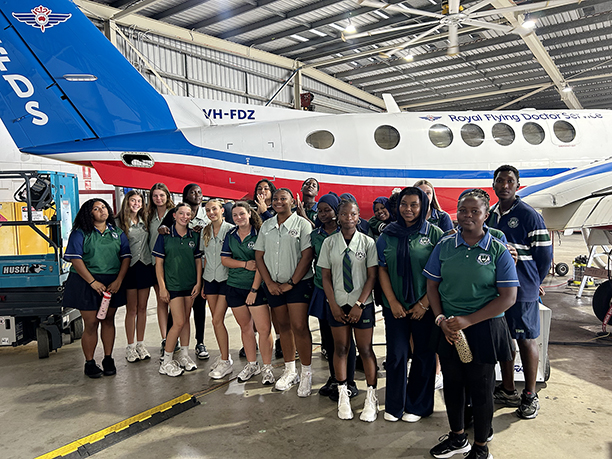
The visit to the Royal Flying Doctor Service (Queensland Section) was a highlight of the day, giving students the opportunity to see firsthand the vital role the service plays in supporting remote and regional communities. Students spoke with flight nurses, toured the aircraft, and met with staff who coordinate and deliver healthcare programs for people who cannot easily access medical services in regional and remote areas.
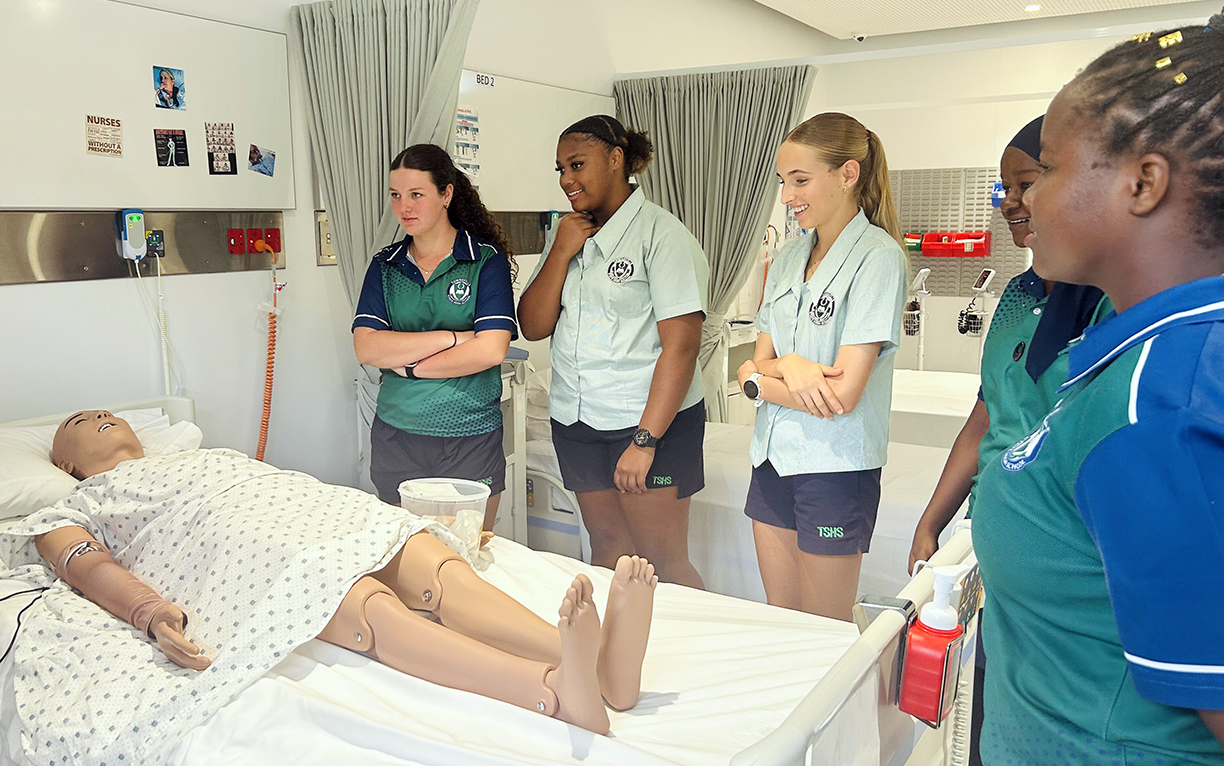
Future healthcare professionals get a firsthand look at life in the industry.
Explore Gateway to Industry School Program – Health
The Gateway to Industry Schools Program – Health (Health Gateway Project) is being delivered by CheckUP in partnership with Queensland’s Department of Trade, Employment and Training.
The Gateway to Industry Schools Program is a key industry engagement strategy for DTET and aligns with the department’s vision for all Queenslanders to have the skills and opportunities to participate and prosper in the economy. There are 11 industry sectors involved in the program.
The Health Gateway Project links schools with industry partners to introduce students to the many career pathways and job options available to them within the health industry. The project also helps to facilitate learning opportunities and experiences for both students and teaching staff.
Want more stories?
Read about regional, rural and remote stories that are making a real difference.
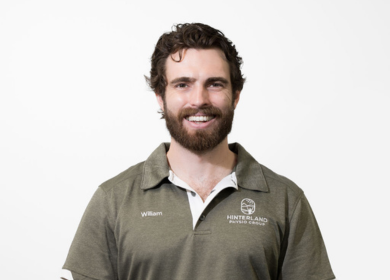
William (Bill) Hinds
Physiotherapist, Hinterland Physio Group
There’s a version of physiotherapy that happens in well-equipped city clinics, with referral networks a phone call away and specialists down the road. Then there’s Kilkivan.
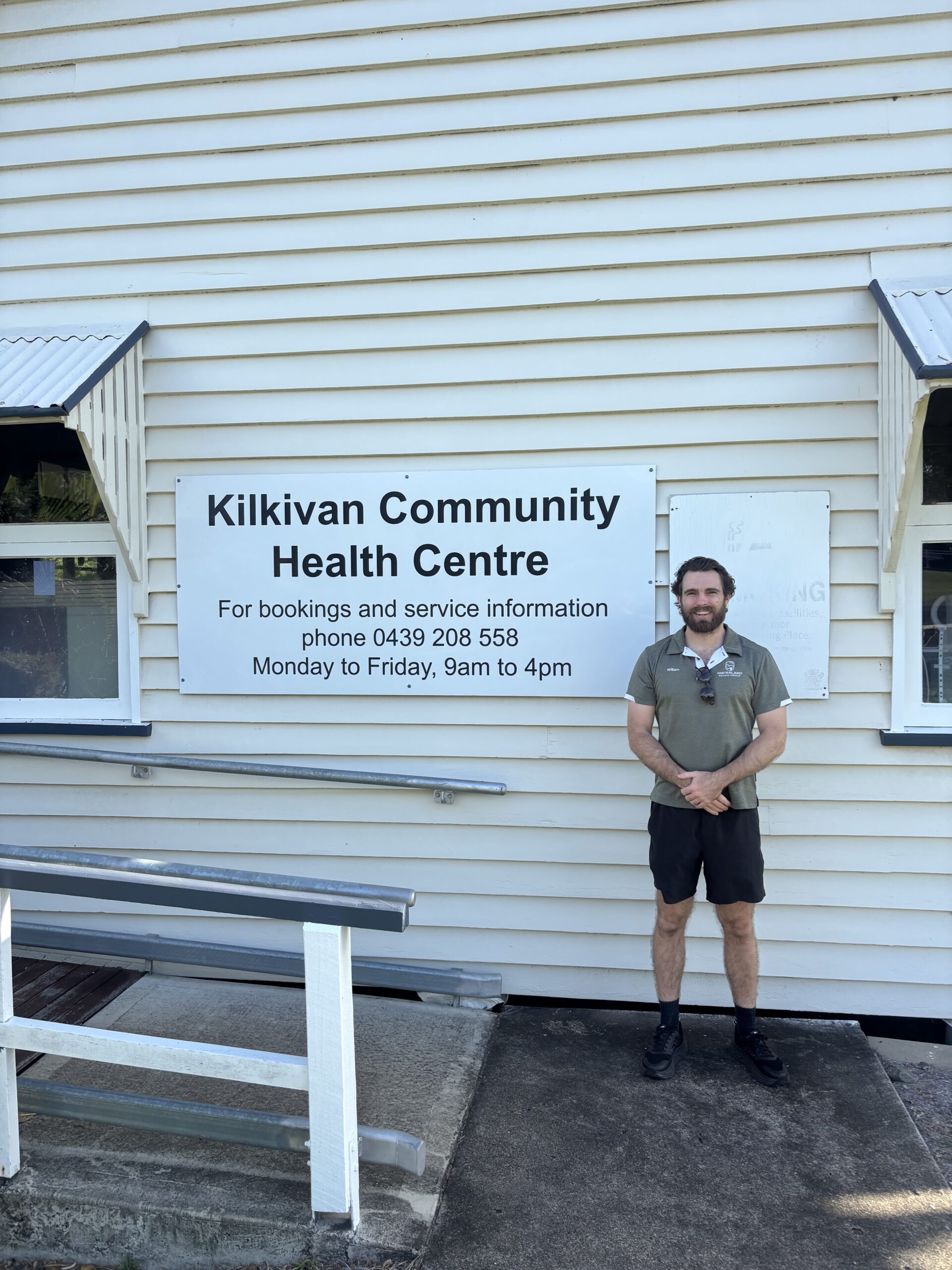
For William (Bill) Hinds, a physiotherapist from Hinterland Physio Group who has been doing outreach work in the small South East Queensland town for several years, the contrast couldn’t be sharper. And he wouldn’t trade it.
“The mix of patients you see in Kilkivan is quite varied. But the big difference is that you don’t have the same referral options available, so it pushes you to treat conditions that in a metro setting you might often refer on for.”
When the referral network is you
In a single day, Bill might develop an exercise program for a cardiovascular patient he’d normally refer to an exercise physiologist, complete an in-home assessment and order support aids that would typically involve an OT, and treat a vestibular (your body’s balance and spatial awareness system) patient he’d usually send to a specialist.
That breadth isn’t incidental to the work. It is the work.
Planning for the long game
One of the less obvious ways rural outreach reshapes clinical practice is in how you think about time. Bill and his team visit Kilkivan once a month, which means the standard week-to-week treatment rhythm simply doesn’t apply.
That kind of long-horizon planning, building a program a patient can sustain largely on their own between visits, is a skill that transfers directly back into everyday practice. It demands a level of patient education and self-management design that busy metro clinics don’t always require.
“This forces you to think differently with how you treat and plan for these patients, developing a plan on how to manage their condition not only over the next week, but also over the next month until we see them again.”
Creativity as a clinical skill
Limited resources have a way of sharpening thinking. In Kilkivan, the pools, gyms, recovery devices, and support networks that city-based clinicians take for granted are often unavailable or hard to access. That constraint, Bill says, is actually one of the most fulfilling parts of the work.
It’s a form of clinical creativity that doesn’t get taught in a textbook. The ability to problem-solve in real time, with what’s in front of you, for someone who has no other option.
“You are working in different environments, with limited resources to both you and the patient for their recovery. This forces you to think outside the box and work with the patient to figure out how we can help with the resources available.”
Showing up matters more than you think
Beyond the clinical skill-building, Bill speaks about something harder to measure but equally important: the power of simply being a consistent presence for patients in rural Queensland communities who have very few other options.
That reassurance sometimes extends well beyond physiotherapy. Patients raise things outside Bill’s scope, but he sees that as part of the role. Listening, and helping point them in the right direction.
In communities like Kilkivan, a health professional is rarely just a health professional. They’re often the most consistent point of contact the healthcare system offers.
“Often at rural clinics these patients are very isolated with very limited health professional support. For these patients, the knowledge that you are coming out to visit them on a set date is so powerful and gives so much reassurance to know they are not alone.”
Why hands-on still wins
With telehealth expanding rapidly across rural and regional Queensland, it’s worth asking what in-person Outreach offers that a video call can’t. For Bill, the answer is clear.
Telehealth has its place, he’s clear about that. But there are things that simply can’t happen through a screen.
“The benefits of being able to physically assess and treat a patient, giving them pain relief and increased movement or mobility in real time is far greater. We know from the evidence that this ability to be hands on and create benefit in session increases a patient’s compliance with their home exercise program and therefore improves patient outcomes.”
What he’d tell a younger physio
If a physiotherapist came to Bill wanting to fast-track their development, his advice would be direct.
“If you want to learn resilience, creativity, challenge yourself clinically, and find fulfilment in your work, then Outreach rural clinic work is the way to go. It will get you thinking on your feet, teach you to trust yourself and your clinical judgment, all while you will make real differences to people’s lives and the community.”
That combination of clinical growth and genuine community impact is what keeps practitioners like Bill making the drive to Kilkivan, month after month.


Read more stories below:
21 January 2026
CheckUP celebrates 10 years as Visiting Optometrists Scheme fundholder
As the Visiting Optometrists Scheme celebrates 50 years of bringing eye care to rural and remote Australia, CheckUP reflects on its own decade of leadership in Queensland.Read more20 January 2026
Kilkivan outreach provider retiring after 12 years of dedicated service
CheckUP recently attended a farewell event in Kilkivan for Dr Sandra Zeeman to celebrate over 12 years of providing Outreach GP services to the community. Dr Zeeman was instrumental in establishing this service back in 2013.Read more11 November 2025
How local healthcare shared one Emerald family’s future for the better
In March 2024, ten-year old Summer’s world shifted in the Emergency Department at Emerald Hospital. Diagnosed with Type 1 Diabetes, Summer was airlifted by a CapRescue helicopter to Rockhampton.Read more20 October 2025
CheckUP’s Health Industry Workforce Advisor brings workforce knowledge to the APNA Festival of Nursing
CheckUP’s Health Industry Workforce Advisor (IWA) Alina Khalid, had an insightful time at the APNA Festival of Nursing, connecting with health leaders from across the country. She explored exciting workforce models that are shaping the future of care, including team-based approaches and the use of AI in health.Read moreCoordination of QMHW to transition to the Queensland Alliance for Mental Health from 2026
The Queensland Mental Health Commission recently announced that the coordination of Queensland Mental Health Week (QMHW) will transition to the Queensland Alliance for Mental Health (QAMH) from 2026, following collaborative planning with CheckUP.
It has been an honour and a privilege for CheckUP to coordinate QMHW, and we thank the Queensland Mental Health Commission for entrusting us with QMHW for the past eight years.
We have striven to ensure that QMHW was celebrated far and wide each year, and we are proud that the number of events held in Queensland grew from 200 in 2018 to a peak of 550.
We know that QMHW will continue to grow under the guidance of the Queensland Alliance for Mental Health – we wish them all the best.
Connect with QMHW on Facebook for further information about QMHW 2026.
Visit QMHW online.
Lilli covers one of Queensland’s most geographically challenging regions, coordinating outreach health services across Far North Queensland (FNQ). Since joining CheckUP in June 2024, she’s become the essential link between providers, hospitals, Aboriginal Community Controlled Health Oranisation (ACCHO)s, and the communities they serve.
My role
Why did you choose to apply for work at CheckUP?
Because I loved the opportunity to travel and engage with communities, which I am very passionate about making a difference in small ways.
What does a typical day at work look like for you?
My typical day at work involves:
- Checking phone messages and attending to urgent emails
- Reviewing the Outreach Dashboard (OR reports, visit dates, etc.)
- Attending Teams meetings and making calls
I continue with addressing any outstanding needs with providers and Hospital and Health Service (HHS), checking overall provider performance, and reading clinician notes. I reach out via call or email to assist outreach services that are struggling or need external support to deliver care.
How does your role contribute to rural and remote communities?
My role contributes through collaboration, engagement, and building trust within communities—including hospitals, ACCHOs, North Queensland Primary Healthcare Network (NQPHN), and partners like NDIS and Aged Care teams. By working across a diversified workforce, we achieve health targets and contribute immensely toward closing health gaps.
What’s the biggest transformation you see with people that you support?
The biggest transformation is seeing that they no longer have to leave their families to travel long distances for services, witnessing the smiles on their faces, and having the community acknowledge our work.
What’s your favourite part about CheckUP?
My role as Regional Coordinator FNQ. CheckUP gave me the opportunity and flexibility to own my role and work collaboratively with stakeholders, providers, and clients to deliver health services.
What’s the most rewarding part of your role?
Making a difference in the community through the delivery of priority needs with the support of outreach teams—bringing better healthcare closer to home.
Lilli’s advice for people considering rural support work
“Do not come with set expectations. Be flexible, have patience, and be able to build trust. Listen and learn about the people, adopt an open-minded approach, and be cheerful. Every location has a unique approach, but just be who you are—you are there to deliver the service and care for the community.”
Where can people contact you?
Reach out directly via email at ltomonu@checkup.org.au or call – 0499 743 203.
Learn more about CheckUP Health Services
Read more stories below:
21 January 2026
CheckUP celebrates 10 years as Visiting Optometrists Scheme fundholder
As the Visiting Optometrists Scheme celebrates 50 years of bringing eye care to rural and remote Australia, CheckUP reflects on its own decade of leadership in Queensland.Read more20 January 2026
Kilkivan outreach provider retiring after 12 years of dedicated service
CheckUP recently attended a farewell event in Kilkivan for Dr Sandra Zeeman to celebrate over 12 years of providing Outreach GP services to the community. Dr Zeeman was instrumental in establishing this service back in 2013.Read more11 November 2025
How local healthcare shared one Emerald family’s future for the better
In March 2024, ten-year old Summer’s world shifted in the Emergency Department at Emerald Hospital. Diagnosed with Type 1 Diabetes, Summer was airlifted by a CapRescue helicopter to Rockhampton.Read more20 October 2025
CheckUP’s Health Industry Workforce Advisor brings workforce knowledge to the APNA Festival of Nursing
CheckUP’s Health Industry Workforce Advisor (IWA) Alina Khalid, had an insightful time at the APNA Festival of Nursing, connecting with health leaders from across the country. She explored exciting workforce models that are shaping the future of care, including team-based approaches and the use of AI in health.Read moreThe January 2026 edition of Reaching Out
The latest Reaching Out newsletter celebrates the dedicated providers and practitioners making a difference in rural and remote Queensland. This edition farewells Dr Sandra Zeeman after 12 years of outreach GP services in Kilkivan and marks CheckUP’s 10-year milestone as fundholder for the Visiting Optometrists Scheme.
Readers can also find updates on patient feedback surveys, upcoming service delivery audits, and congratulations to Dr Rolf Gomes (2026 QLD Australian of the Year), Floyd Leedie OAM, and Dr Sangla OAM for their contributions to rural and Indigenous health.
CheckUP celebrates 10 years as Visiting Optometrists Scheme fundholder
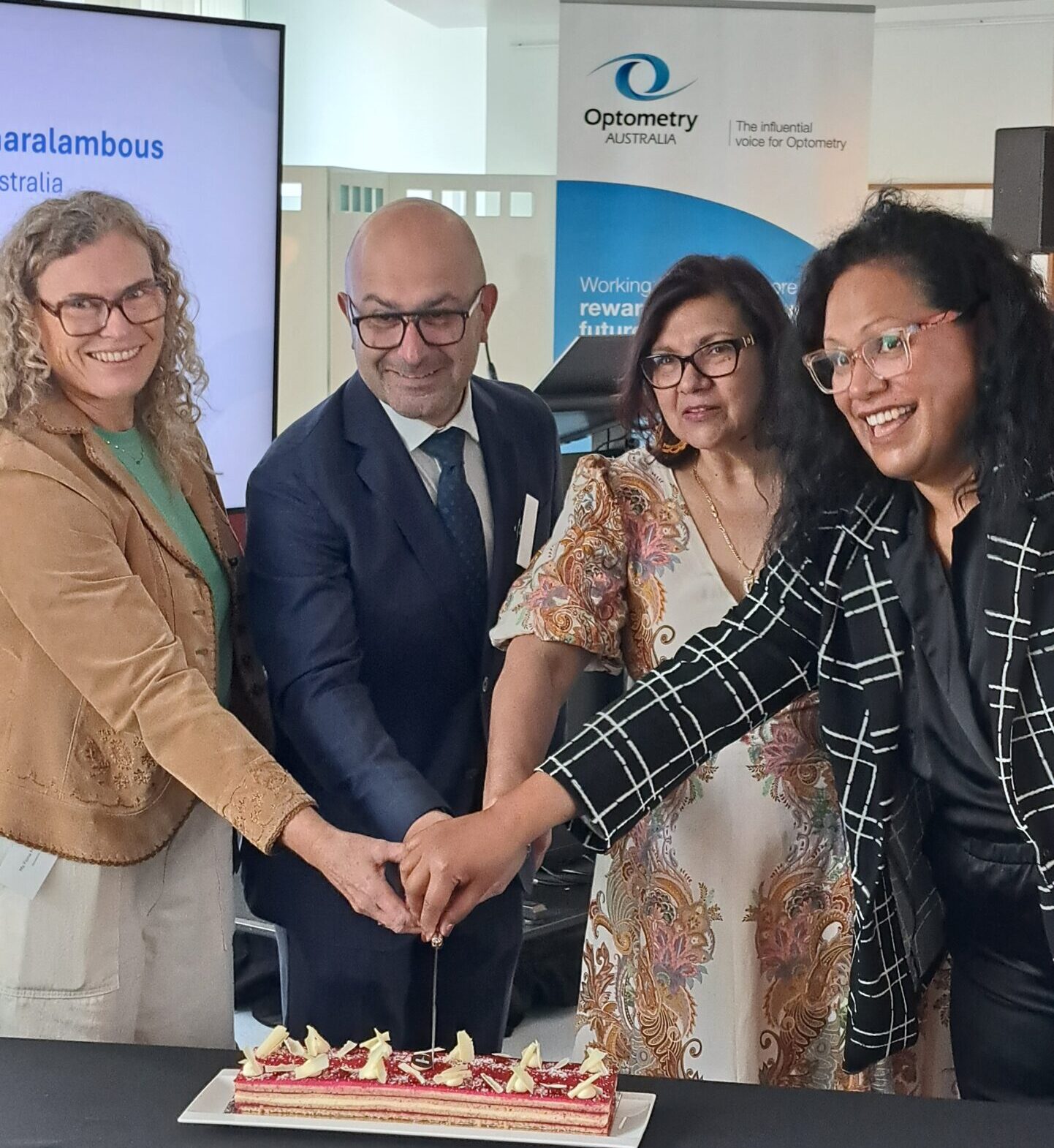
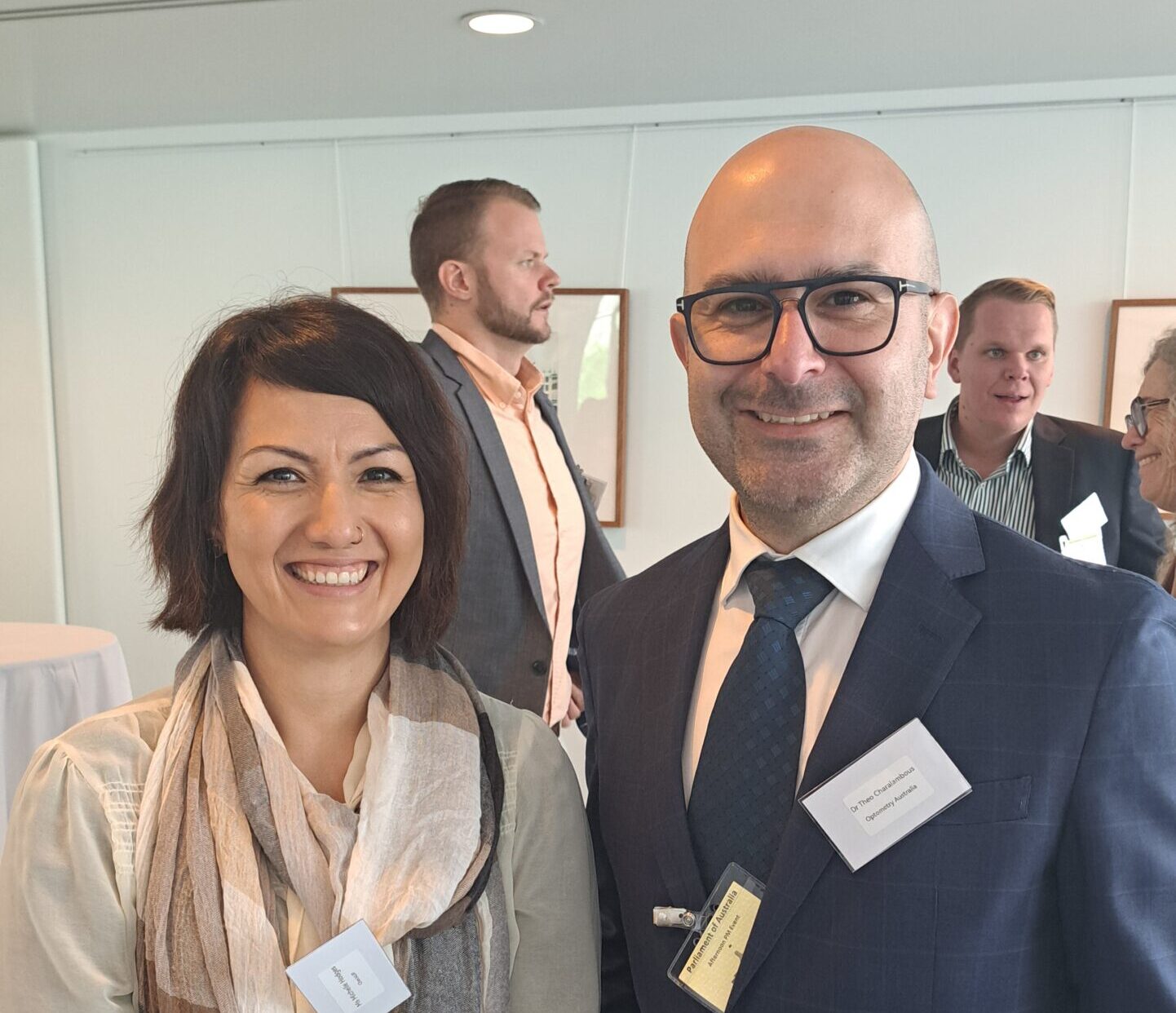
Left to Right: Fiona Moore (Optometry Qld/NT and CheckUP VOS Provider), Dr Theo Charalambus President Optometry Australia, Monica Barolits-McCabe (Executive Director, NACCHO), Lose Fonua (CEO, First Nations Eye Health Alliance), Michelle Hodges, CheckUP
50 Years of Outreach Eye Care Across Australia
As the Visiting Optometrists Scheme (VOS) marked its 50th anniversary in 2025, Optometry Australia hosted a celebration at Parliament House in Canberra. For fifty years, VOS has ensured people in regional, rural, and remote communities can access essential eye care, prevent avoidable vision loss and help bridge longstanding health inequities.
As the jurisdictional fundholder of VOS for over 10 years, CheckUP were pleased to attend the event during National Rural Health Month alongside key stakeholders.
10 Years supporting eye care in Queensland
CheckUP proudly reflects on its own decade of leadership as Queensland’s jurisdictional fundholder. Over the last 10 years, CheckUP has supported outreach providers by managing funding, facilitating service planning and referral pathways, and collaborating with Aboriginal and Torres Strait Islander communities and key stakeholders.
This work has helped maintain continuity of care and ensured VOS services remain aligned with cultural, geographic, and logistical realities across Queensland. Throughout this time, CheckUP has strengthened partnerships with optometrists, local health providers, and community organisations, ensuring services are responsive to local needs and delivered seamlessly.
Image – Fiona Moore (Optometry Qld/NT and CheckUP VOS Provider)
Queensland VOS Outreach: 2024–25 by the numbers
112
communities received VOS optometry visits
1,148
visits delivered across the state
19,738
occasions of service provided
12,377
accessed by Aboriginal and Torres Strait Islander people
Growing Queensland’s outreach optometry network
Several VOS providers have been with CheckUP since 2015 when we started with 11 providers – this has now grown to 21. Along with the communities they serve, we are very appreciative of their commitment and dedicated service to delivering outreach.
Image – Dr Shelley Hopkins QUT, Gayle Stallard CheckUP, Tanya Morris, Country Director – Indigenous Australia Program | The Fred Hollows Foundation
The future of outreach eye care in Queensland
As VOS enters its next 50 years, CheckUP celebrates the shared achievements of providers, partners, and communities. The organisation remains committed to supporting equitable access to eye care for rural, remote and Aboriginal and Torres Strait Islander communities, and continuing its role in sustaining and strengthening the VOS legacy across Queensland.
Image – Senator the Hon Anne Ruston (Shadow Minister for Health and Aged Care)
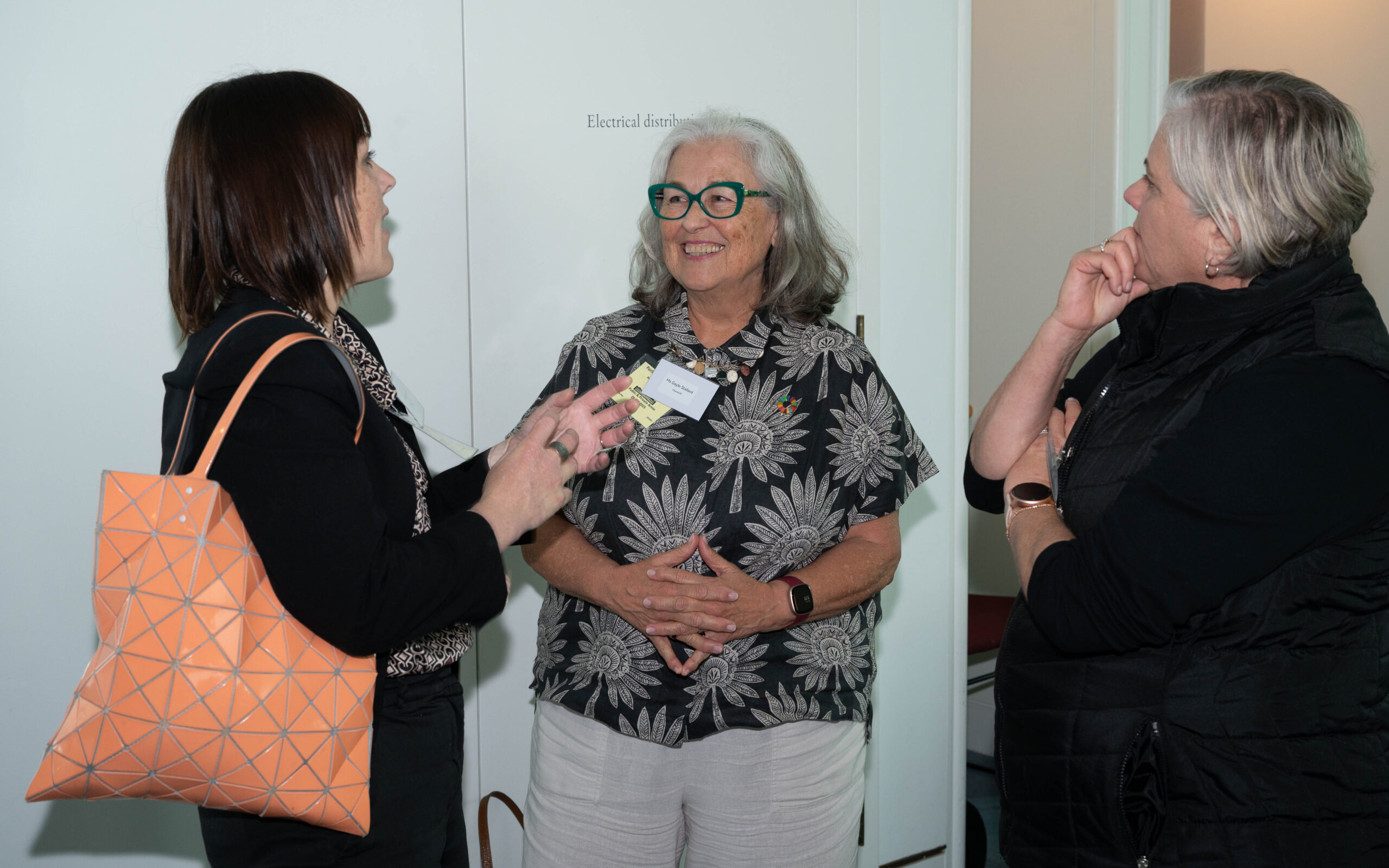
Dr Shelley Hopkins QUT, Gayle Stallard CheckUP, Tanya Morris, Country Director – Indigenous Australia Program | The Fred Hollows Foundation
Want more stories?
Read about regional, rural and remote stories that are making a real difference.
Kilkivan outreach provider retiring after 12 years of dedicated service
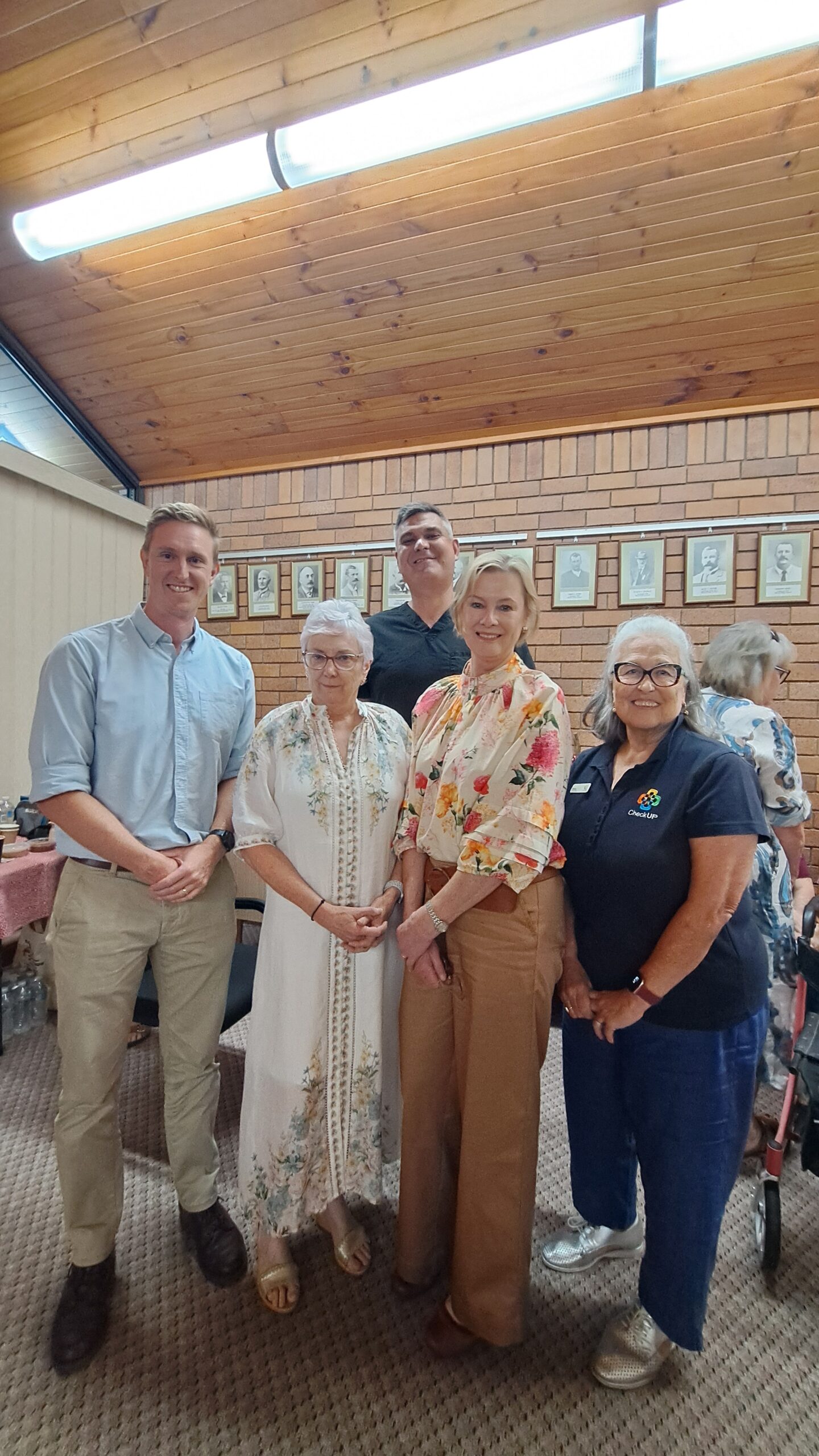
CheckUP’s Gayle Stallard recently attended a farewell morning tea in Kilkivan to celebrate the remarkable contribution of Dr Sandra Zeeman, who has been delivering outreach GP services to the community for over 12 years.
A service built from the ground up
The Kilkivan model wasn’t your typical outreach service. Built from the ground up, it later became known as the Kilkivan Community Health Hub. Located in a house in the small Kilkivan community, the service began as a collaborative effort between community members, Gympie Regional Council, Sunshine Coast Medicare Local (now Country to Coast PHN), and CheckUP – all working together to provide access to a local GP service.
As the service grew, the need for additional support quickly became clear, along with increasing demand for allied health professionals. Today, the community has access to two GPs, a Nurse Practitioner, a Physiotherapist, and a Podiatrist. In previous years, the service also included a counsellor.
CheckUP’s Regional Coordinator, Amber Hanks, regularly checks in with all stakeholders to ensure community needs continue to be met through these services.
CheckUP’s commitment to the Kilkivan community and their ageing-in-place goals will continue, supported by the Australian Government’s Rural Health Outreach Fund.
Celebrating Dr Sandra Zeeman’s 12 years of service to Kilkivan
Dr Zeeman was instrumental in establishing the service back in November 2013, with her first visit on 21 November that year.
In her farewell speech, Dr Zeeman said that serving the Kilkivan community was the highlight of her career. She is delighted to be leaving the community in good hands, having recommended Dr James Mann and Dr James Pearson and supported their transition into the role.
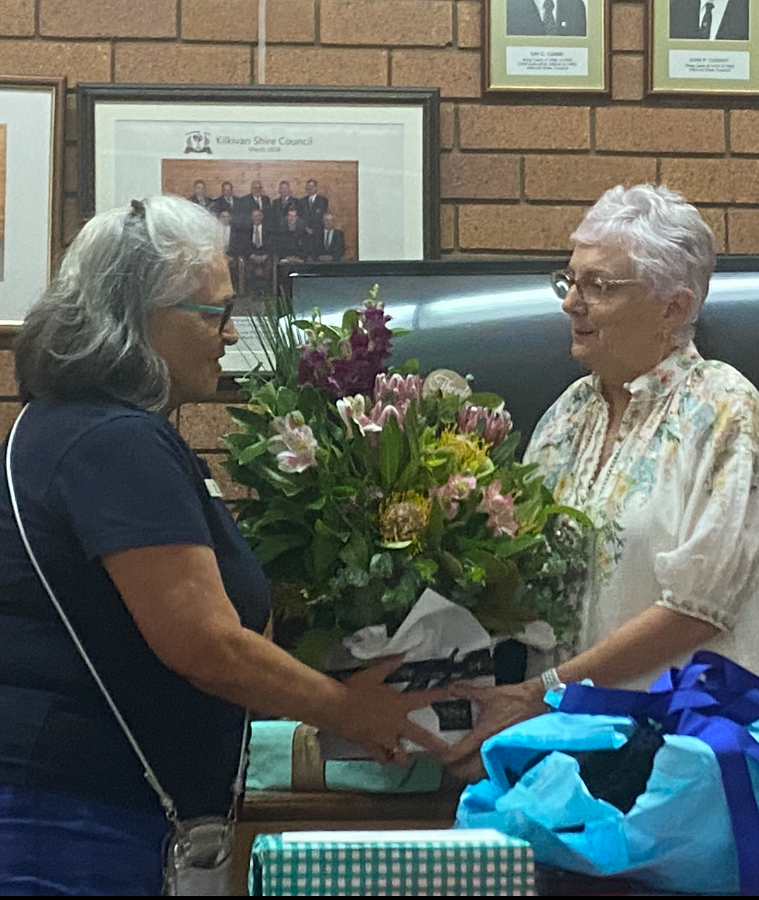
CheckUP thanked Dr Zeeman for her years of dedicated service and presented her with a farewell gift.
For more news and stories
Visit our news and publications page
Disability Action Week Highlights, 2025 QPHCN Event
CheckUP brought together health professionals, community leaders, and disability advocates for our final Queensland Primary Healthcare Network (QPHCN) event of 2025, exploring the theme “Communicate. Connect. Create.”
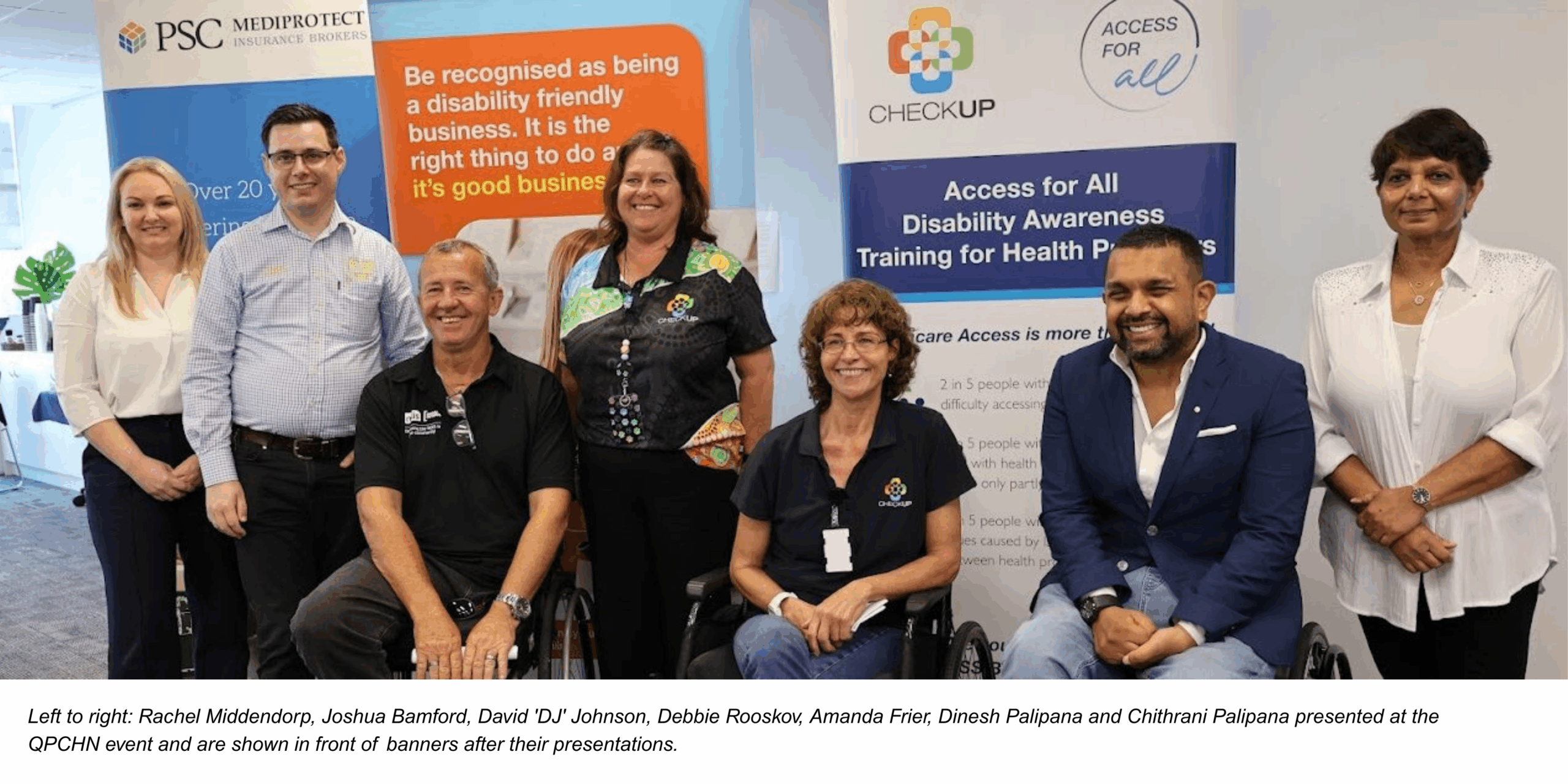
Hosted by Dr Dinesh Palipana OAM (doctor, lawyer, researcher and disability advocate), the event featured powerful conversations about what inclusion really means. The day highlighted inspiring examples from Joshua Bamford on practical disability employment at M&H Ward (McDonald’s) Australia, DJ on his inclusion in schools program reaching 5,000+ students yearly with Social Futures, and Chithrani Palipana on vocational rehabilitation and creating pathways for people with disability.
Debbie Rooskov presented CheckUP’s Disability Friendly Business Basics micro-credential program, designed to help small businesses unlock the disability customer base while building genuine inclusion. The credentials focus on appropriate services, challenging biases, and effective communication.
The event explored real barriers and real solutions. From employment success stories to education programs that shift how young people see disability, speakers shared lived experience alongside practical strategies.
Dr Dinesh Palipana OAM reflected on the 2025 Disability Action Week theme and said, “If we are talking about communicating, I think we have to transcend geography. We have to transcend borders. We have to transcend race, ethnicity, all of these things. We have to be brave enough to talk to people with different ideas. So communication takes courage, and it takes a sense of adventure to wander into the other side and talk to people who don’t believe and to try and generate ideas through robust discussion.”
Watch the event
Resources
Joshua Bamford’s Presentation
View hereDebbie Rooskov’s Presentation
View hereGain more information about Access for All
Access for All is an online course that aims to improve disability awareness among health providers and increase understanding about the barriers people with disability experience when accessing healthcare.
Register TodayBecome a disability friendly business
Disability Friendly Business Basics (DFBB) is a training program that teaches businesses how to be more accessible and welcoming to customers and employees with disability.
It’s an online course that covers topics such as making your physical space easier to navigate, communicating more effectively with people who have different needs, and understanding disability inclusion basics.
It’s designed for any business (trades, retail shops, cafes) that wants to serve everyone in their community better and create a more inclusive environment.
Register TodayEager to attend future events?
CheckUP hosts networking and learning events throughout the year across Queensland.
These gatherings bring together health professionals, community leaders, and service providers to share knowledge, build connections, and explore ways to collaborate.
Whether you’re interested in workforce development, disability inclusion, or reconciliation work, there’s an event coming up that might interest you.
Follow us on Humanitix to stay in the loop about what’s next and stay tuned for QPHCN 2026 dates!
Register TodaySponsor acknowledgement: Thank you, PSC MediProtect

We gratefully acknowledge PSC MediProtect for their support. From humble beginnings in September 1999, PSC Mediprotect has grown to become a market leader in innovative insurance solutions for health professionals, medical, and affinity groups. A commitment to these markets has seen the company develop unique products. PSC MediProtect sponsorship means we can facilitate events to raise disability awareness.